
Our Services
Request an appointment
Reserve your spot with our medical team in just minutes.
Revision Rhinoplasty in Jaipur | Corrective Nose Surgery by Dr. Sushrut Kalra
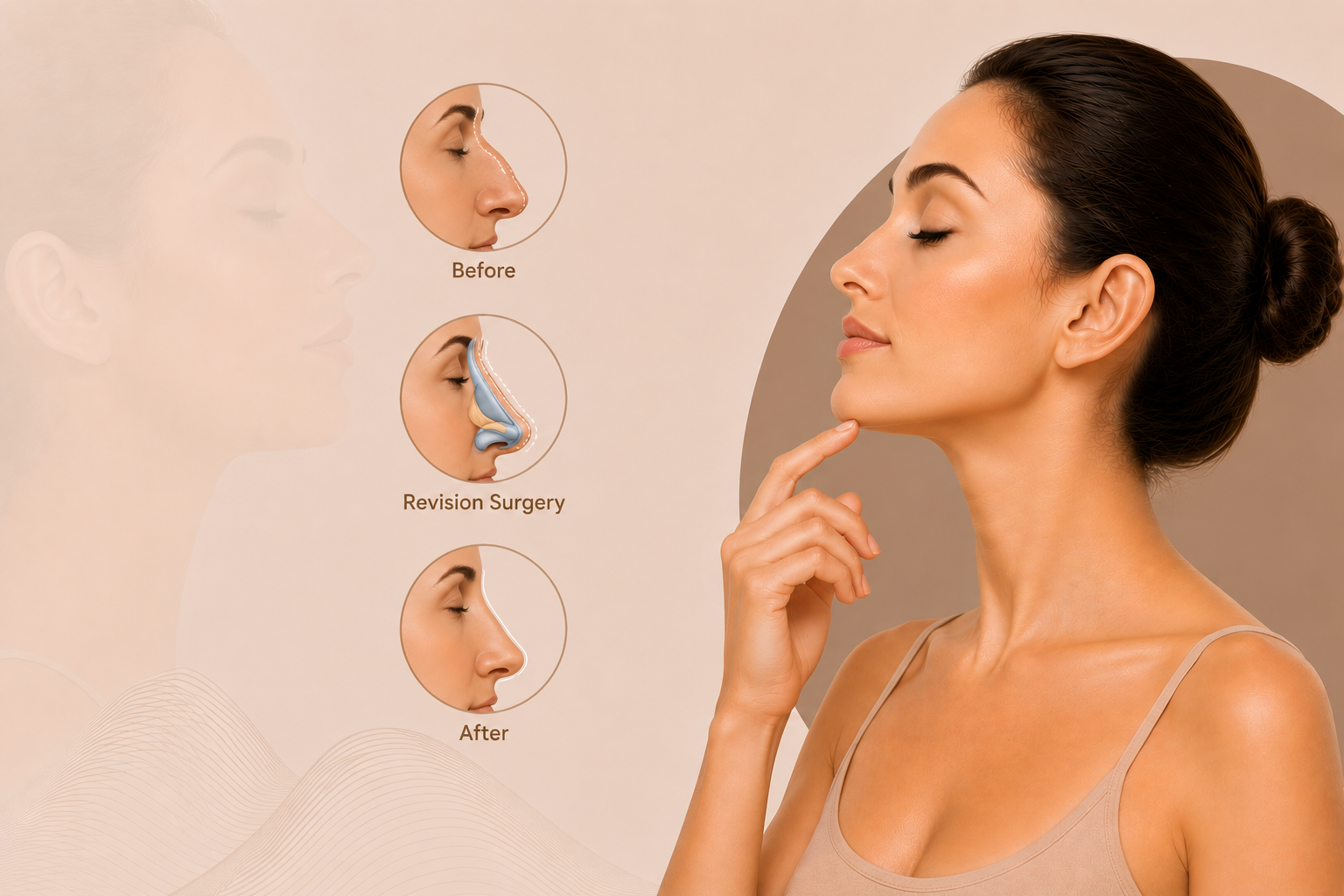
Revision rhinoplasty, or corrective nose surgery, is one of the more technically demanding procedures in facial plastic surgery. It's performed to fix structural, functional, or aesthetic issues left behind by a previous nose surgery, such as a collapsed middle section, a pinched tip, uneven nostrils, or ongoing breathing problems.
Dr. Sushrut Kalra specializes in advanced revision rhinoplasty in Jaipur. Since previous surgery often leaves scar tissue and reduced cartilage available for use, Dr. Kalra uses rib or ear cartilage, along with supportive tissue techniques, to restore both a healthy airway and a natural, balanced profile.
Complex Concerns Addressed in Corrective Nose Surgery
-
Middle Vault Collapse Happens when too much cartilage or bone was removed in a previous surgery. This is corrected using cartilage grafts that widen the airway and smooth the bridge.
-
Pinched Nasal Tip Occurs when too much tip cartilage was removed previously, causing the nostrils to look unnaturally narrow. This is corrected by rebuilding the tip using cartilage grafts.
-
Collapsed Bridge from Cartilage Loss When septal cartilage has already been used in a previous surgery, rib cartilage can be used to rebuild a strong, stable bridge.
-
Uneven or Retracted Nostrils Corrects nostrils that appear pulled up or uneven, using cartilage and tissue grafts to restore a more natural nostril shape.
-
Scar Tissue Management Careful surgical technique is used to work through scar tissue from previous surgery, often combined with fascia grafting for a smoother result.
-
Ongoing Breathing Problems Addresses breathing issues caused by untreated septal deviation or collapsed nasal valves, alongside correcting appearance.
Frequently Asked Questions
It's a corrective nose surgery performed after a previous procedure that left aesthetic or breathing issues. It's complex because it involves working with scar tissue and reduced cartilage availability.
It's generally recommended to wait at least 12 to 18 months, so swelling can fully settle and the tissue has time to soften and heal.
In these cases, cartilage is usually taken from the rib or the ear to provide the structural support needed for reconstruction.
Yes, restoring healthy airflow is a major focus, often achieved by rebuilding the nasal valves and correcting any remaining septal deviation.
Most cases use an open approach with a very small incision under the nose, which typically heals into a fine, barely visible line.
Most patients need about 10 to 14 days off from work. Since the tissue has already been operated on once, swelling can take longer to settle, often 18 to 24 months for final results.